


Cutting the Fat: Reducing Waste for Operational Efficiency
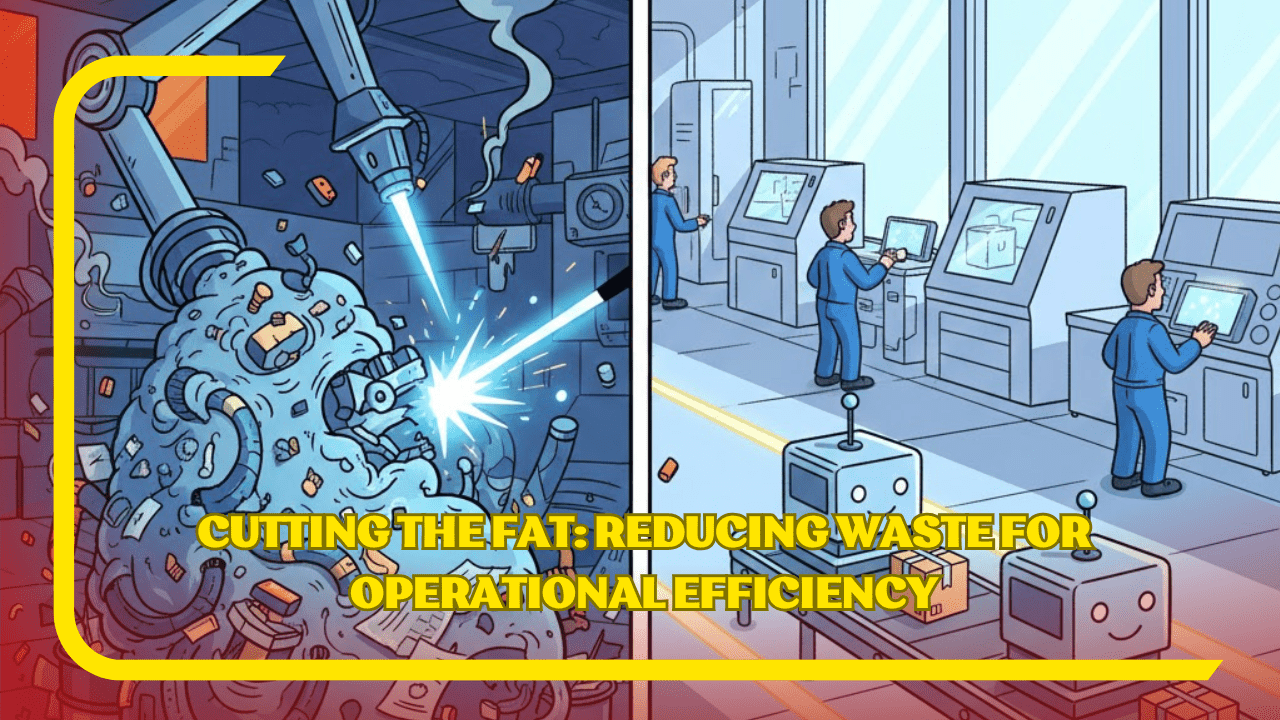
Have you ever taken a closer look at the daily operations within your organization and questioned how much of it truly matters to your customers or even to your business goals? You may be surprised to realize that more than 80% of the activities in most work processes are non-value-added that is, they do not directly contribute to what the customer wants, nor do they support the organization in achieving meaningful outcomes.
These activities, though often seen as routine or necessary, consume time, resources, and energy without adding any real benefit. This concept, widely supported by Lean and Six Sigma practitioners, highlights a harsh reality in modern businesses: we often mistake being busy for being productive. For instance, consider the healthcare sector the nurses and doctors are frequently overwhelmed not just with patient care but with documentation, billing entries, and navigating multiple software systems. A nurse may spend only 30% of her shift in direct patient care, while the rest is consumed by non-clinical administrative work. None of these backend tasks improve the patient experience or outcomes, yet they remain embedded in the system.
In the manufacturing industry, a classic example comes from the automotive sector. An assembly line might seem efficient on the surface, but a deeper look often reveals workers waiting for parts due to poor planning (waiting waste), walking long distances to fetch tools (motion waste), or creating excess inventory “just in case” (overproduction waste). Toyota famously reduced such waste through Lean manufacturing by streamlining its processes to only what added value to the customer delivering high-quality vehicles on time without unnecessary steps.
In corporate offices, another common scenario plays out: employees spend hours preparing slide decks for weekly status meetings, which are neither reviewed properly nor drive decisions. These reports are often created to satisfy internal protocol, not because they serve a real business purpose. Similarly, in customer service centres, agents often enter the same customer data into multiple disconnected systems—this duplication does not serve the customer but is required due to poor systems integration. In one case study from a telecom company, it was discovered that agents were spending 40% of their time switching between up to 12 different software applications to resolve one customer issue. Imagine the customer frustration this causes, not to mention the operational cost.
Even retail businesses are not spared. Sales floor employees may spend substantial time rearranging shelves for aesthetic purposes rather than restocking fast-moving goods or assisting customers. These cosmetic efforts do not necessarily impact customer satisfaction or sales but continue because of outdated merchandising policies.
Across industries, such inefficiencies remain because they go unchallenged. Many are part of the “we’ve always done it this way” culture. Others are disguised as risk management, compliance, or quality checks but lack proper evaluation of their necessity. The danger is that these non-value-added activities give a false sense of control and productivity, while in reality, they slow down decision-making, increase operational costs, reduce employee morale and frustrate customers. The first step toward eliminating them is awareness. Mapping out work processes, questioning each activity’s purpose, and identifying what truly adds value is essential.
Talk to Our Operations Management Consultant
Discover how expert Lean Six Sigma consultants leverage military-grade planning to transform your efficiency, adaptability, and performance.
Achieve peak performance— see how we can transform your operations today.
Eliminating process waste is one of the most effective ways for an organization to improve its overall efficiency. Waste, in this context, refers to any activity or resource use that does not add value from the customer’s perspective or support a strategic business objective. When such non-value-added activities are identified and removed, organizations can experience dramatic improvements in speed, cost-effectiveness, quality, and customer satisfaction.
First and foremost, reducing waste leads to faster processes. Many workflows are slowed down by unnecessary steps such as waiting for approvals, redundant data entry, excessive meetings, or rework due to defects. By streamlining these processes and removing bottlenecks, tasks can be completed more quickly and with less effort. For example, a finance team that eliminates redundant verification steps in their invoice processing can reduce turnaround time significantly. This speed not only enhances internal efficiency but also leads to faster delivery of products or services to customers, which is a key competitive advantage.
Become a Lean Six Sigma Black Belt Leader
Master advanced process improvement, data-driven decision-making, and strategic leadership. Our globally recognized Lean Six Sigma Black Belt certification equips you to lead transformation, drive operational excellence, and mentor high-performing teams.
Take the lead—enroll in our Black Belt training with Lean Partner today!
Secondly, cutting waste reduces operational costs. Non-value-added activities consume resources whether it’s employee time, materials, energy, or system capacity without contributing to outcomes that matter. For instance, overproduction in manufacturing not only ties up inventory and space but also incurs holding and storage costs. When waste is removed, resources can be reallocated to value-creating work, reducing overhead and increasing profitability. Additionally, employees can focus on high-impact tasks instead of routine or administrative duties that provide little return.
Another major benefit is improved quality. Many forms of waste, such as defects, rework, or overprocessing, directly compromise product or service quality. By focusing only on necessary steps and reducing complexity, organizations reduce the risk of errors and inconsistencies. For example, a streamlined software development cycle that eliminates unnecessary documentation and approval stages is more likely to produce reliable and user-focused applications in shorter timeframes. A consistent and simplified process is easier to monitor, control, and improve.
Moreover, waste reduction leads to higher employee morale and productivity. When employees are burdened with inefficient workflows, repeated tasks, or pointless activities, it can cause frustration and disengagement. On the other hand, when they see that their time is respected and their contributions are focused on meaningful outcomes, they feel more valued and motivated. Lean organizations often empower employees to identify and solve inefficiencies in their own work areas, which creates a culture of continuous improvement and ownership.
Lastly, eliminating process waste strengthens the organization’s agility and adaptability. In today’s fast-changing business environment, companies must respond quickly to customer demands, regulatory changes, and market shifts. Efficient processes free from waste and allow for faster decision-making and smoother transitions. Whether launching a new product, entering a new market, or dealing with supply chain disruptions, organizations with lean operations are better prepared to adapt and respond with confidence.
In today’s fast-paced and highly competitive business ecosystem, improving process efficiency is no longer optional it is a necessity for survival and growth. With globalization, technological disruption, and rising customer expectations, companies must operate leaner, faster, and smarter to remain relevant. Process efficiency plays a vital role in enabling this transformation. improving process efficiency enhances speed to market. Customers today expect rapid service, quick deliveries, and instant access to solutions. Businesses that operate with efficient workflows can innovate faster, launch new products quickly, and respond promptly to market changes. In contrast, organizations bogged down by slow, manual, or redundant processes risk falling behind and losing market share to more agile competitors.
Moreover, technology-driven disruption is reshaping every sector from AI and automation to cloud computing and digital platforms. Companies that do not continuously improve their processes will struggle to integrate new technologies effectively. On the other hand, improving process efficiency lays a strong foundation for successful process automation. When organizations streamline their workflows by eliminating redundancies, delays, and non-value-adding steps, it becomes much easier to identify what can and should be automated. Efficient processes are generally more standardized, predictable, and well-documented all key requirements for automation technologies like robotic process automation (RPA) or AI-driven tools to function effectively.
Without prior efficiency improvements, automating a broken or cluttered process can lead to poor results, wasted investments, and system failures. For example, automating a manual data entry task becomes more valuable and error-free only after reducing unnecessary data handoffs or approvals. Furthermore, improving process efficiency enhances visibility and control, allowing organizations to set clear goals for automation, such as reducing cycle time or increasing throughput.
In essence, process efficiency removes the “waste” and exposes the core steps that truly matter making automation simpler, faster, and more impactful. It also boosts employee productivity, allowing human efforts to focus on higher-value tasks while routine work is handed over to machines. Therefore, process efficiency and automation go hand in hand, reinforcing each other to drive operational excellence, cost savings, and improved service quality.
In summary, process efficiency fuels cost competitiveness, faster innovation, superior customer experience, and long-term adaptability. In the current business ecosystem defined by constant change, shrinking margins, and digitally empowered consumers efficiency is the foundation on which sustainable success is built.
FAQs
Q1. Why shouldn’t we just automate our current processes to save time immediately?
Automating an inefficient process is known as “paving the cow path.” While it might provide a temporary speed boost, it ultimately codifies errors and scales waste. If a process has redundant approvals or unnecessary steps, automation will simply perform those useless tasks faster, wasting computing power and making the system harder to fix or update later.
Q2. How do I identify “waste” in a digital or office environment?
In an office, waste is often “invisible.” Look for the “Eight Wastes” (DOWNTIME):
Defects: Reworking reports or correcting data entry.
Overproduction: Creating reports no one reads.
Waiting: Delays in signatures or system lag.
Non-utilized Talent: Assigning experts to do manual data entry.
Transportation: Moving files between too many digital folders/platforms.
Inventory: Backlogs of unread emails or unprocessed applications.
Motion: Switching between 10+ tabs or apps to complete one task.
Extra-processing: Requiring five signatures when two would suffice.
Q3. Will simplifying processes make my employees feel redundant?
On the contrary, simplification usually improves morale. Most employees are frustrated by “busy work” and “red tape.” By removing non-value-added tasks, you allow your team to focus on high-impact, creative, and strategic work that humans do best, leaving the repetitive “drudgery” to the machines.
Q4. What are the best tools for mapping a process before we automate?
You don’t need complex software to start. Effective tools include:
SIPOC Diagrams: To identify Suppliers, Inputs, Processes, Outputs, and Customers at a high level.
Value Stream Mapping (VSM): To visualize the flow of information and pinpoint where delays occur.
Swimlane Flowcharts: To see exactly how many times a task “jumps” between departments (a common source of waste).
Q5. How do I know when a process is “simple enough” to be automated?
A process is ready for automation when it is standardized, predictable, and optimized. If you can describe the process using clear “If-Then” logic without dozens of “exceptions to the rule,” and if every step left in the process provides direct value to the end customer, you are ready to automate.