


Why Lean Six Sigma Certification Is a Smart Career Move for Malaysian Professionals
Introduction
Career growth is not always about changing jobs or collecting more qualifications. In many workplaces, professionals progress when they can solve difficult problems, help teams work better, and show how their contribution improves business results. These abilities matter in Malaysia’s diverse economy, where organisations across manufacturing, logistics, finance, healthcare, technology, and services need reliable processes and consistent customer experiences.
Lean Six Sigma certification can be a useful step for professionals who want to develop those capabilities. It introduces a structured way to understand how work is performed, identify avoidable waste, investigate errors, and test improvements using evidence. Rather than relying only on instinct or temporary fixes, learners practise asking what is happening, why it is happening, and how a change can be measured.
Certification alone will not guarantee a promotion, a higher salary, or a new job. Its value depends on the quality of the training, how well the skills match your role, and whether you apply what you learn. For Malaysian professionals who want to strengthen their problem-solving skills and prepare for broader responsibilities, Lean Six Sigma can be a practical career investment.
Table of Contents
- What Lean Six Sigma Certification Teaches
- Why Process Improvement Matters to Malaysian Employers
- Career Benefits Beyond the Certificate
- Industries Where the Skills Can Be Applied
- Understanding Yellow Belt, Green Belt, and Black Belt
- How to Choose the Right Training Programme
- Turning Training into Workplace Results
- Common Mistakes to Avoid
- Is Lean Six Sigma Right for Your Career Goals?
- Conclusion
1. What Lean Six Sigma Certification Teaches
Lean Six Sigma combines Lean principles, which aim to remove activities that do not add value, with Six Sigma methods that help reduce defects and variation. Together, they give professionals a repeatable way to examine a process and improve its performance.
Training may introduce process mapping, root-cause analysis, the Five Whys, cause-and-effect diagrams, Pareto analysis, and performance measurement. More advanced programmes may include deeper statistical methods, project selection, and improvement leadership. The precise content varies by provider, so learners should check the syllabus before enrolling.
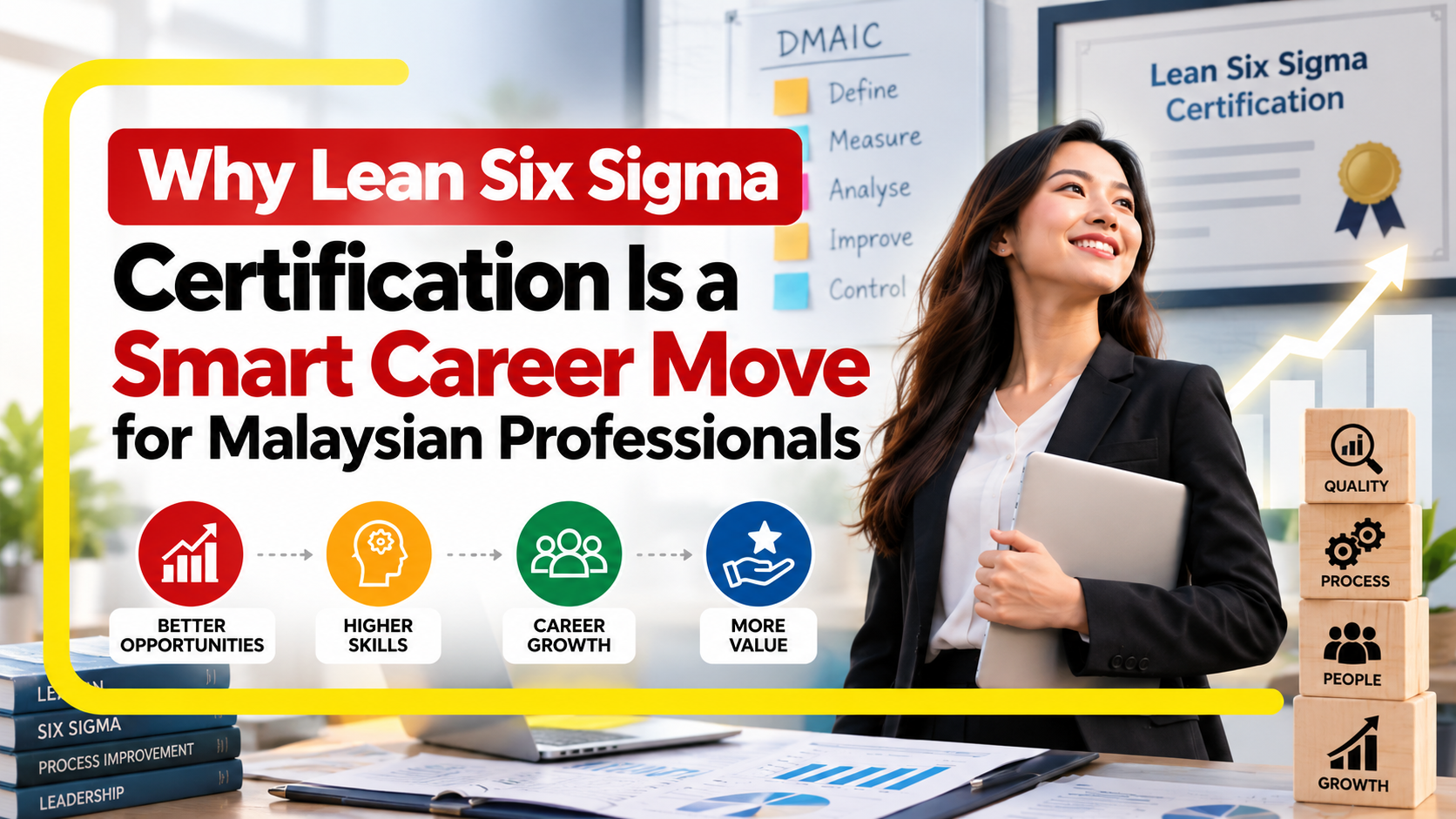
An important concept is DMAIC: Define, Measure, Analyse, Improve, and Control. A team first agrees on the problem, records current performance, investigates likely causes, tests a solution, and then monitors the process to ensure the improvement continues. This structure can help prevent teams from jumping to a solution before understanding the problem.
For example, if a customer service team is missing response-time targets, the first idea might be to hire more staff. A process review could reveal that requests are being assigned incorrectly or that employees repeatedly ask customers for information already supplied. Understanding the actual cause can lead to a more targeted improvement.
2. Why Process Improvement Matters to Malaysian Employers
Organisations need processes that deliver the right outcome without unnecessary delay, rework or expense. In a competitive market, even small inefficiencies can affect customer satisfaction and employee workload when they occur repeatedly.
Manufacturers may need to reduce defects and production interruptions. Logistics providers may focus on delivery accuracy, stock visibility and warehouse flow. Banks and service teams may want to shorten approval times while maintaining controls. Technology teams may look for ways to reduce recurring incidents and improve testing. Human resources departments may need to make recruitment, onboarding or payroll procedures more reliable.
Lean Six Sigma gives employees a common approach to discussing these issues. Instead of saying that a department is slow, a team can measure the time taken at each stage, identify where work waits and determine which causes contribute most to the delay. A specific problem is easier to investigate and easier for managers to evaluate.
For professionals, understanding this way of working can make their contribution more visible. They can help connect day-to-day tasks with broader goals such as service quality, productivity, cost control and customer retention.
3. Career Benefits Beyond the Certificate
Stronger Problem-Solving
Lean Six Sigma encourages professionals to examine evidence, test assumptions, and distinguish a root cause from a symptom. This approach can be useful when the same issue returns despite repeated attempts to fix it.
Better Use of Data
Learners practise defining measures and comparing performance before and after a change. This does not mean every decision must be statistical; it means using appropriate evidence instead of relying only on opinions.
Improved Project Coordination
Improvement initiatives often involve several people or departments. Setting a clear scope, assigning responsibilities, tracking actions, and sharing progress can help professionals manage work more effectively.
Clearer Communication
Leaders must explain the problem, the evidence, and the proposed solution to colleagues with different levels of technical knowledge. Turning analysis into a clear business explanation is a valuable professional skill.
Greater Readiness for Responsibility
Employees who can help organise an improvement effort may be better prepared to contribute to quality, operations, business analysis, or project work. Whether this leads to a new role depends on the employer and the results demonstrated.
A Stronger Professional Portfolio
A completed project can give a candidate a concrete example to discuss during a performance review or interview. It is more persuasive to explain the problem, personal contribution, measure, and outcome than to list a certificate without practical context.
4. Industries Where Skills Can Be Applied
Manufacturing and Engineering
Teams can examine scrap, rework, machine downtime, inspection failures, and production bottlenecks. Improvements should be measured carefully so that faster output does not compromise safety or product quality.
Logistics and Supply Chain
Process mapping can reveal delays between order entry, picking, packing, and dispatch. Teams may also investigate stock discrepancies, damaged goods, or repeated delivery exceptions.
Banking, Insurance, and Finance
Professionals can study incomplete applications, avoidable processing steps, transaction errors, and customer waiting time while respecting regulatory and data-protection requirements.
Healthcare and Support Services
Administrative teams may review appointment booking, documentation, supply replenishment, or billing workflows. Any improvement must preserve patient safety and relevant professional standards.
Information Technology
IT teams can analyse repeat service desk tickets, slow incident resolution, defects discovered late in testing, or hand-offs between development and support.
Human Resources and Shared Services
Recruitment, employee onboarding, payroll, claims, and leave approvals are repeatable processes that can be measured and improved. A clearer checklist or better hand-off may reduce missing information and repeated follow-up.
These are examples rather than guaranteed outcomes. The right project depends on the organisation’s needs, available evidence, and the professional’s role.
5. Understanding Yellow Belt, Green Belt, and Black Belt
Yellow Belt
Yellow Belt programmes generally introduce the basic concepts and tools. They can suit beginners or employees who want to participate more confidently in improvement teams.
Green Belt
Green Belt training commonly develops more practical analysis and project skills. It may suit supervisors, executives, engineers, analysts, and other professionals who support or lead appropriately scoped projects alongside their regular responsibilities.
Black Belt
Black Belt programmes typically cover more advanced analysis and the leadership of complex, cross-functional improvement projects. They may be relevant to experienced practitioners whose work involves guiding teams or leading larger initiatives.
Master Black Belt
Some providers also offer Master Black Belt pathways, often intended for experienced practitioners who mentor others or support improvement programmes across an organisation.
Names and requirements are not identical across all providers. Before choosing a level, check prerequisites, assessment methods, project expectations, course delivery, trainer experience, and the recognition that matters in your sector. A higher belt is not automatically the best choice if you have not yet had the chance to apply the fundamentals.
6. How to Choose the Right Training Programme
Start with your career objective. If you want to understand improvement terminology and contribute to a team, an introductory course may be sufficient. If you expect to manage projects, look for a programme that includes project definition, analysis, implementation, and control.
Review the syllabus in detail. Check whether it covers practical case studies, exercises, assessment, and opportunities to apply the methods. Ask how the provider evaluates learning and whether you will receive feedback on project work.
Consider schedule, delivery format, cost, and support after the course. The most suitable option is one you can complete properly and use in your work, not necessarily the programme with the most advanced title.
Professionals exploring Lean Six Sigma certification in Malaysia can review available options through LeanPG. Compare the programme details with your current experience and intended responsibilities before making a decision.
7. Turning Training into Workplace Results
To make the training worthwhile, identify a manageable problem in your workplace. Choose an issue that occurs often enough to study and matters to a customer, colleague, or business outcome.
Define what success means before changing anything. For example, a team might aim to reduce the number of incomplete forms returned for correction. Record the current rate, agree on a realistic target, and decide how the measure will be collected.
Talk to the people who perform the process. They often understand the workarounds and practical constraints that are not visible in reports. Map the steps, examine the evidence, and test potential causes before selecting an intervention.
Where possible, trial the solution on a small scale. Compare results with the baseline and check whether the change has created a new problem elsewhere. If it works, document the updated process, assign ownership, and continue monitoring it.
Keep a short project record with the initial problem, your role, tools used, baseline, action taken, and verified result. Do not claim savings or percentage improvements unless they were actually measured. This record can support discussions with managers and future employers.
8. Common Mistakes to Avoid
Treating Certification as a Guarantee
A certificate demonstrates training or assessment according to a provider’s requirements; it does not, by itself, prove that someone can lead every type of project.
Choosing a Level Based Only on Its Title
Select training that matches your experience and offers a realistic path to practical application.
Using Tools Without a Clear Problem
A diagram or chart is only useful if it helps answer a specific question. Start with the business issue and choose tools that fit it.
Ignoring the People Affected
A technically sound change may fail if employees are not consulted, trained, or given the resources to use it.
Failing to Sustain the Result
Improvements need an owner, suitable procedures, and periodic checks. Without these, teams may return to the previous way of working.
Overloading a CV with Jargon
Explain what you improved and how you measured it in language that a hiring manager can understand.
9. Is Lean Six Sigma Right for Your Career Goals?
Lean Six Sigma may be a good fit if your role involves repeatable processes, quality, operations, customer service, analysis, or project coordination. It may also be useful if you want to contribute more confidently to cross-functional improvement initiatives.
Before enrolling, ask yourself three questions. First, can you identify a real process at work that could benefit from improvement? Second, will your role give you access to the people and information needed to study it? Third, does the programme teach skills that match the responsibilities you want next?
If the answer to these questions is yes, training may provide a useful structure for developing your capabilities. If you cannot yet access a workplace project, look for practical exercises or case studies and plan how you will apply the learning when an opportunity becomes available.
10. Conclusion
Lean Six Sigma certification can be a smart career move for Malaysian professionals when it supports a clear goal and leads to practical application. It can help learners approach problems systematically, interpret performance data, coordinate improvement work, and explain the value of a change.
The best return comes from combining training with experience. Choose a programme that fits your current level, apply the tools to a real challenge, and record results honestly. Over time, these examples can help demonstrate your contribution to quality, efficiency, and customer outcomes.
If you are considering Lean Six Sigma training in Malaysia, compare the available learning pathways and select one that fits your experience and ambitions. The certificate can start the journey; the improvements you help deliver are what make the skills meaningful.
Frequently Asked Questions
1. Which belt should a beginner choose?
Yellow Belt is often an introduction, while Green Belt usually covers more applied project work. Review each provider’s syllabus and prerequisites before deciding.
2. Can non-engineers learn Lean Six Sigma?
Yes. The methods can be applied to many administrative and service processes, including HR, finance, customer support, and IT, although the tools used will depend on the problem.
3. How long does it take to complete Lean Six Sigma certification?
The duration varies by certification level and training provider. Some introductory programmes can be completed relatively quickly, while advanced courses may require more study, assessment, or project work. Check the specific programme details before enrolling.